Classification & Reinforcement Learning
A two-part machine learning project: supervised classification of network intrusions (KDD dataset) and reinforcement learning on a Gridworld environment, with several algorithms reimplemented from scratch.
Context
An academic project meant to demonstrate command of the main families of machine learning, from generative models to reinforcement learning. It combines a supervised part on real, heavily imbalanced data and a reinforcement part on a custom-built environment, under the constraint of implementing some algorithms without any dedicated library, to prove understanding of the underlying mechanisms rather than just their use.
Approach
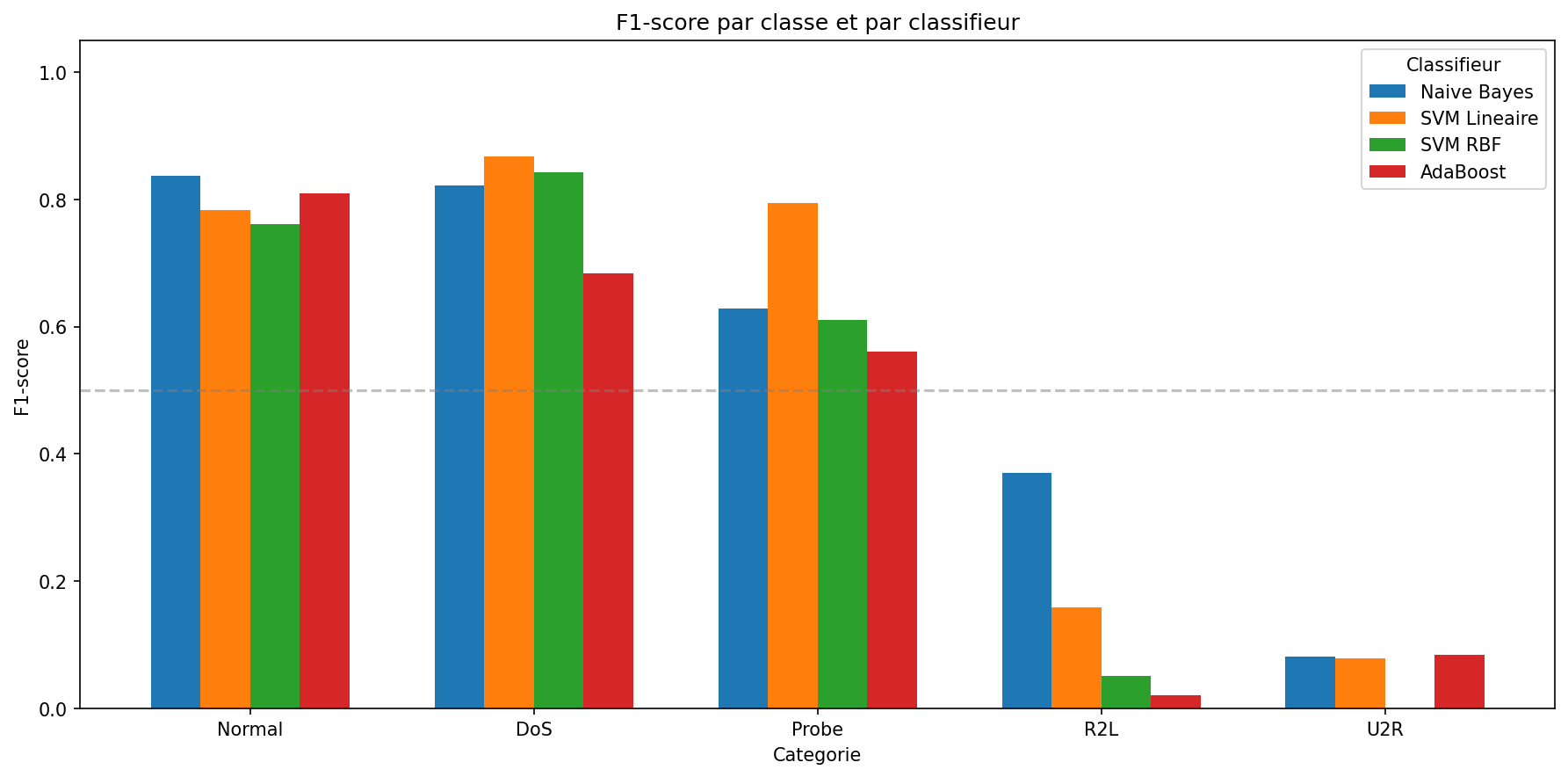
Classification part: on the KDD network intrusion detection dataset (five classes: normal traffic, DoS, Probe, R2L and U2R), after preprocessing that combines scaling of numerical features and one-hot encoding of categorical ones, three families of methods are compared: a generative approach (Gaussian Naive Bayes), a discriminative approach (SVM) and an ensemble method (AdaBoost). The strong class imbalance is handled by choosing suitable metrics (F1, per-class recall and precision, confusion matrix) rather than accuracy alone, and hyperparameters are tuned through cross-validation. AdaBoost (the SAMME variant on decision stumps) is fully reimplemented by hand, then validated against scikit-learn's reference implementation.
Reinforcement part: on a stochastic 5x5 Gridworld (slippery moves, 80 percent in the intended direction and 10 percent skidding to each side, with a goal reward, a trap penalty and a step cost), two algorithms are written from scratch. With known transitions, dynamic programming (value iteration from the Bellman equations) yields the value function and the optimal policy. With unknown transitions, Q-learning learns through interaction with epsilon-greedy exploration. A sensitivity study on the discount factor, the learning rate and the exploration rate, together with a learning curve, accompanies the comparison of the two policies.
Results
Both from-scratch implementations are validated: the hand-written AdaBoost is checked against the scikit-learn reference, and the policy learned by Q-learning is compared with the one obtained through value iteration. The project shows an end-to-end grasp of a model's lifecycle (preprocessing, metric choice justified by the data, comparison of algorithm families, bias-variance reading) and of the foundations of reinforcement learning, beyond simply calling libraries.