Pecule
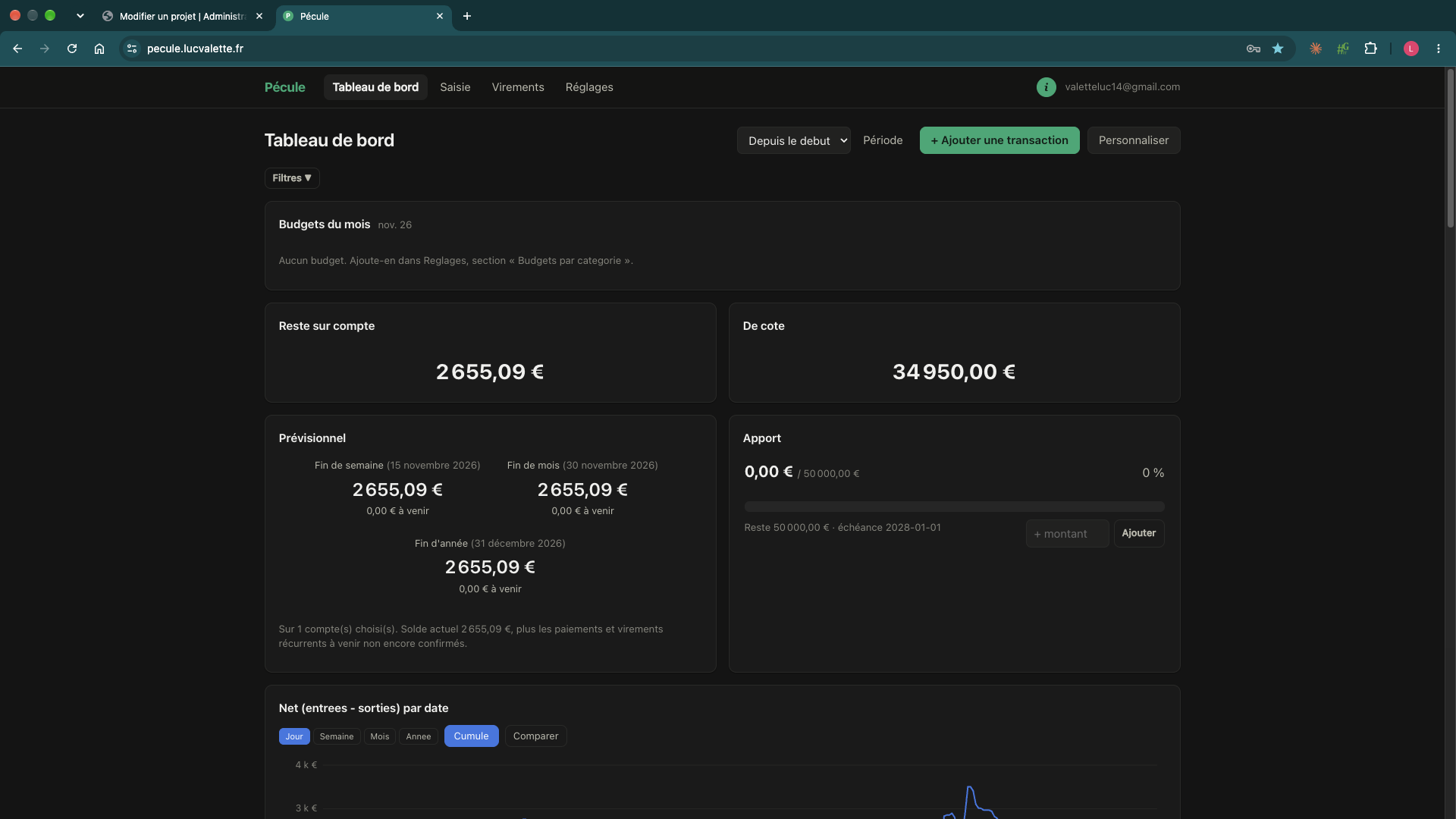
A multi-user personal finance web application where each person tracks their accounts, transactions, savings and budgets on a dashboard whose charts they can customize. Built with React and Node on a PostgreSQL database, deployed in containers on my own server, where it is now used by several people.
Context
Family budget tracking used to live in Notion, convenient for data entry but limited for visualizing and cross-referencing figures. The goal was a dedicated, multi-user tool where each person manages their own accounts in isolation, with clear dashboards and a lossless migration of the existing history. Everything is hosted on my own domain, so that such sensitive data never depends on a third-party service. What started as a family tool is now used by several people and has grown through their feedback.
Approach
The application is a TypeScript monorepo: a React front end (Vite) and a Node API (Fastify) sharing the same schemas, with PostgreSQL for persistence. Each user has their own accounts and transactions, strictly isolated down to the database (per-user composite keys), with invitation-code signup and session handling.
The dashboard gathers cards that each user arranges and customizes (chart type, color, title, order, width, period), with a custom chart builder (a measure, a grouping, filters) computed on the server in SQL under the same isolation, and a pivot table with two free axes. Alongside account tracking, and driven by user feedback, came monthly budgets by category (caps split across sub-categories, real-time consumption, threshold alerts and a revision recommendation after repeated overruns), savings goals and recurring operations.
Migrating existing data is handled by an import script that reads the Notion CSV export in a single transaction (nothing is changed if an error occurs) and automatically reconstructs transfers between accounts. On the performance and eco-design side, charts were moved from SVG to canvas rendering, which cut the dashboard DOM nearly in half and lightened the page. Security and robustness were given care: rate limiting, a database and API never publicly exposed, a front end served behind an HTTPS reverse proxy, and an integration test suite run against a real PostgreSQL database (105 tests at the latest count). Deployment is fully containerized with Docker Compose (database, API, front end), migrations are applied automatically on startup, and regular backups are scheduled.
Results
A personal finance tool in production, self-hosted on my own infrastructure and used daily by several people. The project demonstrates command of a modern full web stack end to end (TypeScript shared between front and back, a tested API, a relational database), the design of a multi-user application with data isolation, the incremental building of features from real feedback (budgets, goals, recurring operations, analytics), a containerized and secure deployment, and attention to performance and eco-design. It is the project that most closely ties together my development and server administration skills.