Robile Navigation ROS2
A complete autonomous navigation and exploration system for the Robile robot platform, built with ROS2: the robot localizes itself within a map, plans a path to a goal while avoiding obstacles, and explores an unknown environment on its own.
Context
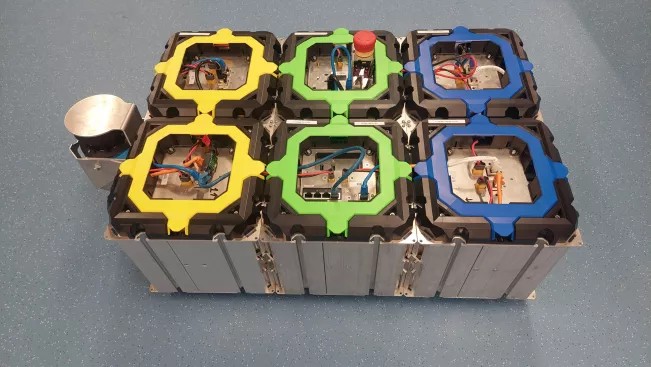
A team project carried out in an academic setting around the Robile mobile platform and the ROS2 ecosystem. The goal was to implement, from scratch, the three core building blocks of an autonomous mobile robot without relying on ready-made navigation stacks: knowing where you are, deciding where to go, and mapping what you do not yet know. The system was validated in simulation and then on the real robot.
Approach
The project is organized as a ROS2 package (Python) bringing together three independent nodes that communicate through topics.
Localization relies on a particle filter (Monte Carlo Localization): a cloud of two thousand particles represents the robot's possible poses within the map. On each move, a motion model propagates the particles from odometry, then a measurement model reweights them by comparing the laser reading (LaserScan) against the known map, before resampling. The pose estimate and the particle cloud are published for visualization in RViz.
Path planning combines two levels. A global A* planner computes a route on the occupancy grid using a Manhattan-distance heuristic, then extracts a sequence of waypoints from it. A potential-field local planner follows these waypoints while reacting in real time to obstacles detected by the laser (a repulsive component), allowing the robot to go around an obstacle that is not present on the map. Velocity commands are sent to the robot's control topic.
Exploration is frontier-based: the node identifies the cells sitting at the boundary between free and unknown space in the occupancy grid, selects a frontier to reach and sends the goal to the navigation system, in a loop, until the area is covered. The whole thing integrates with SLAM Toolbox to build the map as it goes.
Results
A working autonomous navigation pipeline, from positioning to exploration, tested in simulation and on the real Robile robot. The project illustrates the implementation of classic mobile-robotics algorithms (particle filter, A*, potential field, frontier-based exploration), command of the ROS2 architecture (nodes, topics, QoS, launch files) and hands-on work on a physical robot with its constraints (sensor noise, gaps between simulation and reality).