Connected Greenhouse
An autonomous Arduino-based connected greenhouse that senses its environment, drives its actuators (ventilation, watering) and periodically transmits its data over the Sigfox low-power network.
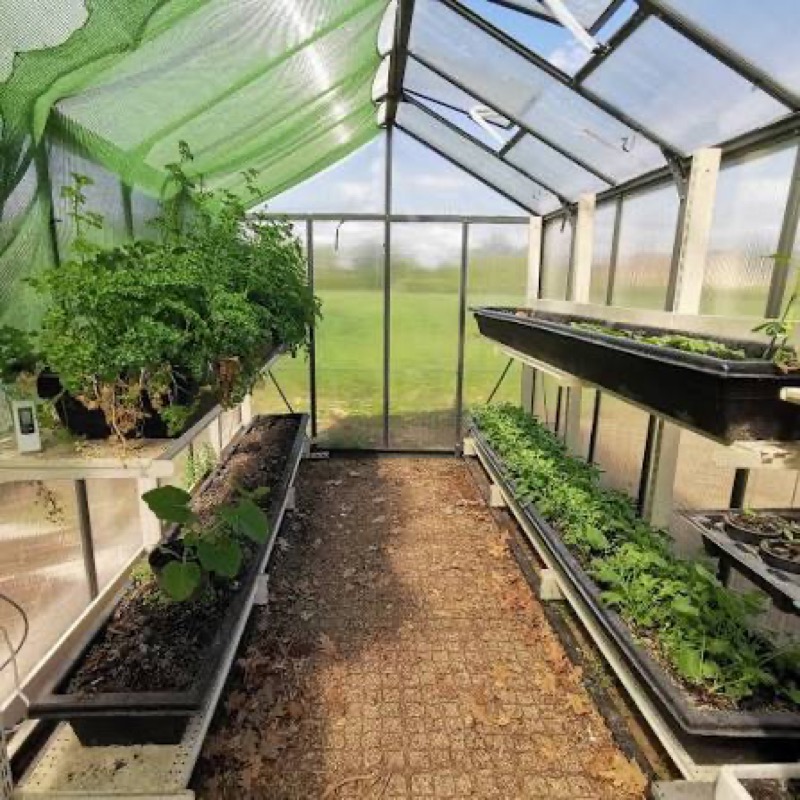
Context
A team project (3iL, 2021-2022, resumed and maintained in 2023) aimed at automating a small greenhouse: keeping temperature and humidity within a plant-friendly range without human intervention, and reporting the greenhouse's state remotely despite the absence of Wi-Fi, thanks to a long-range, very low-power network.
Approach
Built around an Arduino MKRFOX1200 board (with a built-in Sigfox module), the system combines sensors (indoor and outdoor temperature, three humidity readings including soil moisture, light level, water-level floats) and actuators (a window opening for ventilation, watering through a pump and a solenoid valve, lighting). The code is written in object-oriented C++, with one class per component inheriting from shared base classes, all orchestrated by a central class. On each cycle, the system reads the sensors, triggers the actuators based on thresholds (the window opens above a given temperature, watering starts when soil moisture leaves the target range), assembles a compact binary frame (a one-byte status bitfield plus the values) and sends it over Sigfox, then enters deep sleep for about twenty minutes to save battery. On the server side, a PHP callback URL receives and decodes the Sigfox uplink to log the readings.
Results
A greenhouse running autonomously, able to regulate its ventilation and watering and to report its state regularly over a long-range, low-power network. The project illustrates the design of a complete embedded system (sensor, decision, actuator and communication chain), a modular and documented C++ architecture, and the very compact message constraint imposed by Sigfox. One limitation is honestly noted in the code: the AM2320 sensor (indoor temperature and humidity) could not be integrated reliably, an avenue left open for a later version.